Part 3 of 3 Parts
Charles Shearer explained that “Returning these materials that are derived from that impact event and dating them will tell us about the impact history of the inner solar system, including the Earth. It can also tell us a little bit about the migration and the movement of some of the larger planets in the solar system, like Jupiter and Saturn.”
Sharp was the first person to analyze gases taken by from the Apollo 17 mission but never opened. This made The UNM the first university to analyze those gases in 2022.
The UNM has created a smoothly functioning enterprise when it comes to this research by working through different departments The UNM is equipped with sophisticated technology for analyzing these kinds of materials. Sharp explained that the university has purchased an advanced transmission electron microscope, a stable isotope lab, radiogenic isotope labs, X-ray diffraction, X-ray Computed Tomography and more sophisticated equipment.
Shearer said, “We have our small group out here that focuses on planetary materials, but we reach out to biology, engineering, physics and astronomy, and a lot of other departments on campus to really define space exploration and infrastructure.”
Shearer also pointed out that New Mexico is a space-faring state and has a growing space exploration infrastructure. Spaceport America, the Very Large Array, and the various National Labs are excellent examples. There are also numerous private sector companies in New Mexico that are investing in space technology.
Shearer added that “Billions are being invested now to develop the space economy of the moon–Earth, system. It’s extremely valuable to New Mexicans to be involved in the space economy to varying degrees. The purpose of this is also to reach out to the private sector and the national labs to involve them and help develop this New Mexico space economy. The UNM has championed these activities through the Sustainable Space Research Grand Challenge. Further, NASA has supported many of our research programs on the UNM campus. This research is putting us on the ground floor and we’re addressing some fundamental questions.”
Ultimately, the intention is for the lunar samples to be returned and distributed to premier labs in order to analyze and interpret the data.
Sharp said, “In the publication, we talk about the volatile species that we expect to return from the Artemis mission and how we might sample those to curate the most information possible about the moon.”
The LPI examines photographic imagery from satellites orbiting the moon and makes maps of the temperature profiles of the whole region. While these indications help to map out the moon, Shearer and Sharp both say that further missions will confirm what’s actually there.
Sharp concluded that “We are just in the very early phase of space exploration, and we don’t quite know what’s there yet. We don’t know how dangerous it is, how cold it is, or what we’re going to find. Each mission will give us new information that will enable missions to become more sophisticated as we move forward in the exploration of the moon.”Lunar and Planetary Institute
-

Moon – University of New Mexico And Other Institutions Are Studying Volatile Materials From The South Pole Of The Moon – Part 3 of 3 Parts
-

Moon – University of New Mexico And Other Institutions Are Studying Volatile Materials From The South Pole Of The Moon – Part 2 of 3 Parts
Part 2 of 3 Parts
Zachary Sharp is the director of the Center for Stable Isotopes at UNM. The Center specializes in the examination of stable isotopes of hydrogen, oxygen, and a wide range of other elements that can determine and provide a print of where those volatiles came from.
Sharp stated that “No human has been to the south region that is permanently shadowed, so we really don’t know yet what’s actually in there. We have good ideas, but in detail, we don’t know the quantities of water, CO2, other gases, methane, or sulfur. It’s just not completely known.”
This Artemis mission will place samples from the lunar surface in sealed containers and return them to Earth for further analysis. During the initial Artemis missions, the samples that are taken will be kept at higher temperatures than the extreme cold of the lunar cold traps. The questions addressed in this study focus on what information can be gained from these samples. It will be equally important to find out what information will be lost by allowing them to warm to some degree.
One of the main problems with sampling this particular region of the moon is the extreme temperatures. The permanently shadowed regions of the southern pole on the Moon can reach temperatures of minus four hundred and fifty-three degrees Fahrenheit and that will make it very difficult for humans to explore.
Bringing these samples back to Earth at higher temperatures than the extreme cold of the lunar south pole where they were collected will result in changes of these elements from solids to liquids or gases, which could result in the loss of important information and data.
Sharp said, “One of the main efforts of our work was to say how we are going to return these samples at different temperatures and what information will be lost for these different storage conditions and which storage conditions will showcase the conditions closest to the moon”.
Shearer and Sharp were able to review different scenarios with different temperature ranges to investigate what information might be lost. Their research also provided step by step procedures for how to eventually collect these samples to represent how they are where they were collected on the Moon.
Another major concern in collecting these samples is that when the gases are sealed in containers and warmed, they could vaporize and reach extremely high pressures, potentially becoming toxic for human transportation. In addition, the appropriate portion size of the samples needs to be determined.
Shearer said, “There needs to be portions. Whether going to the moon, Mars, or sampling from comets, you need to have the proper engineering, the proper tools to sample and preserve those volatiles. And if you don’t preserve them correctly, you lose information.”
The UNM research laid out the fundamental questions that need to be addressed by the science teams for future lunar missions.
NASA has decided to focus on the south pole region for a variety of reasons, from engineering to scientific. One reason is that humans have never been to that type of terrain. The south pole of the Moon contains shadowed regions along with some of the oldest crust on the Moon and one of the largest impact basins to be found in the solar system.UNM Center for Stable Isotopes
Please read Part 3 next -

Moon – University of New Mexico And Other Institutions Are Studying Volatile Materials From The South Pole Of The Moon – Part 1 of 3 Parts
Part 1 of 3 Parts
There is currently a race to return humans to the Moon and to create permanent habitations there. Aside from the problems of getting to the Moon, there will be many challenges to the creation of permanent habitats. The first tasks will be to find a way to utilize materials on the surface of the Moon to construct the habitats. Once the structures are in place, they must be supplied with energy, oxygen and water. Previous missions to the Moon have indicated that there are deposits of ice at a variety of locations. The big question is where the biggest accessible deposits of ice can be found. Currently, researchers are focusing on obtaining water for habits from one of the poles of the Moon.
Just how cold are the lunar South and North Poles? For comparison, Antarctica’s coastal temperatures average around fourteen degrees Fahrenheit while the interior drops to minus seventy-six degrees Fahrenheit making Earth’s South Pole one of the coldest places on the planet. Recent research indicates that the South Pole of the moon experiences even more extreme temperature fluctuations and freezing conditions.
New research from The University of New Mexico details the exploring, sampling, and interpreting of lunar volatiles in polar cold temperatures on the moon. The team of researchers surveyed the surface of the moon and analyzed permanently shadowed regions that have temperatures of minus four hundred- and fifty-three-degrees Fahrenheit. Inside these shadowed regions, there are cold ‘traps’ that capture and preserve volatiles, such as water, carbon dioxide, and other elements.
The University of New Mexico research was published in the Proceedings of the National Academy of Sciences. Charles Shearer is a research scientist at the Institute of Meteoritics and research professor in the Department of Earth and Planetary Sciences at UNM. He was the lead author, along with UNM’s Zachary Sharp, who co-authored the article, and Julie Stopar at the Lunar and Planetary Institute.
Shearer explained, “There are potential resources on the moon that could be utilized for human activity on the lunar surface and beyond. We all need water. It could also provide oxygen for humans to breathe, and some of the materials could be used for fuels for transporting humans around the surface of the moon or going beyond the moon.”
This new research has implications for NASA’s Artemis Lunar mission to return humans to the moon. Artemis I, was launched in November 2022. It carried an unmanned spacecraft that flew past the moon, orbited it, and then returned to Earth.
Artemis II will follow a similar route, this time with humans aboard, orbiting the moon and returning safely to Earth. Artemis III will be the first crewed mission to the moon’s surface since Apollo 17. It will land at the lunar South Pole to explore its surface, collect samples and return to Earth.
Stopper looked at the orbital data and provided information about the permanently shadowed regions in terms of stability fields. She examined what there could be in terms of volatile materials and temperature ranges, and she showed where permanently shadowed regions are located.The University of New Mexico
Please read Part 2 next -

Space Station – Axiom Space Has Revised The Launch Order For Its Commercial Space Station Modules
The construction of the world’s first commercial space station and a commercially developed Extravehicular Mobility Unit is being undertaken by Axiom Space. Subsystem design, integration, and testing are underway in Axiom’s Houston labs. Following the completion of preliminary and critical design reviews in collaboration with NASA, Axiom partners at Thales Alenia Space began welding and machining activities for the primary structures of Axiom Station’s first module.
The Axiom Extravehicular Mobility Unit spacesuit provides a next-generation spacesuit for NASA’s Artemis Project. Integration and design continue towards providing astronauts with advanced capabilities for space exploration in a commercially developed spacesuit which is needed to access, live and work in low-Earth orbit, on the Moon, and beyond.
Axiom has recently decided to change its method for assembling its commercial space station. By altering the order in which it will launch the station’s modules to Earth orbit, Axiom Space will be able to begin operating a free-flying platform as early as 2028, the Houston-based company announced this week. Axiom previously planned to start operating its private space station in 2030, so the new plan moves up the timeline by two years.
NASA awarded Axiom Space a contract in 2020 to attach one or more modules to the International Space Station. The ISS is set to retire by 2030 at the earliest when it will be deorbited to burn up in the Earth’s atmosphere. The original plan called for Axiom to detach a multi-module group from the ISS when it is retired. The group of Axion modules will become a commercial outpost in low Earth orbit that will continue operating after the ISS is gone. But that plan has now been altered.
Mark Greeley is Axiom Station program manager and Chief Operating Officer. He said last December, “Our ongoing assessment of the assembly sequence revealed opportunities for flexibility and enhancements, With the International Space Station needing to protect for the ability to accommodate a deorbit vehicle on station, we were able to accelerate this work to support the program’s requirements.”
To create its space station, Axiom plans to launch the following five modules: a payload/power/thermal element, an airlock, a research/manufacturing hub, and a pair of habitat modules. The original plan called for Axiom to launch the Habitat 1 module to the ISS first, followed by the additional elements.
The revised assembly sequence calls for the Payload, Power and Thermal module launch to the ISS first. This module could detach from the station to become a free flyer called Axiom Station as soon as 2028, according to the company.
Greeley said, “Our goal is to ensure a smooth transition from a government to a commercial platform, maintaining a continuous human presence in orbit to serve a community of global customers and partners, to include NASA.”
Founded in 2016, Axiom Space made history with its Ax-1 mission in April 2021. The company became the first to deliver a flight of all private citizens to the ISS.
With the ISS’ impending retirement, a new era of private space stations is set for the coming years. SpaceX, Blue Origin, Sierra Space and others are all looking to play a role.Axiom Space -

Spacecraft – Microcosm Inc Published A Design For A Cheap Adaptable Spacecraft To Aid Space Exploration
A spacecraft that can provide the propulsion necessary to reach other planets while also being reproducible, relatively light, and inexpensive would be a great benefit to larger space missions in the inner solar system.
Microcosm Inc. which is based in Hawthorne, California, has proposed such a system. Its Hummingbird spacecraft would provide a platform to visit nearby planets and asteroids and a carry a payload to do some basic scouting of them.
Large space missions are very expensive. Using a much less expensive spacecraft to collect preliminary data on the mission target could potentially help save money on the larger mission’s final design. That is the role that Hummingbird was designed to play. It is essentially a propulsion system, with slots for radiation-hardened CubeSat components as well as a larger exchangeable payload, such as a telescope.
The critical component of the Hummingbird was its propulsion system. It was designed to use a rocket engine that burns hydrazine fuel, and it would hold a lot of that fuel. A fully assembled system was expected to weigh fifty-five pounds without propellant installed. A fully fueled system would weigh an estimated one hundred and seventy-six pounds.
That would give Hummingbird plenty power to bring its orbital speed up to an estimated two miles per second delta-V. This velocity is required for getting to hard-to-reach objects like some near-Earth asteroids. It could have also reach other places, such as Mars or even Venus, the various Lagrange points, or even Mars’ moons.
In celestial mechanics, the Lagrange points are points of equilibrium for small-mass objects under the gravitational influence of two massive orbiting bodies. When the spacecraft arrived, the prototype of Hummingbird described in a paper presented back in 2013 would take images of its target world using an Exelis telescope.
The company that manufactures this telescope has since been bought by Harris Systems, which was then merged into L3Harris Technologies, the owner of Aerojet Rocketdyne. However, the authors of the Hummingbird proposal stress that the payload itself would have been interchangeable and could have been tailored to the mission that it was meant to scout.
The Hummingbird bus design also contained the fuel tank, and it had additional slots for CubeSat components. These components could have been used for a variety of purposes such as further data collection or data analysis. However, the paper doesn’t mention how Hummingbird would have handled standard CubeSat operations, like attitude control or communications back to a ground station. Those operations could likely have been worked out in future iterations. Additionally, the final design was published before the dramatically reduced cost of getting to orbit, which is now available. The authors don’t even mention a SpaceX ‘Falcon’ as a potential launch service. A great deal has changed in the space industry in the last eleven years.
The concept behind Hummingbird, an inexpensive, adaptable platform for preliminary scouting missions to interesting places in the inner solar system, has yet to see its day in the sun. The project did not receive a Phase II Small Business Innovation Research grant, which could have continued its development. But maybe it or a similar system will eventually contribute to the exploration of interplanetary space.
MICROCOSMINC.COM -
Propulsion – Ad Astra Rocket Company And Space Nuclear Power Corporation Collaborating On Nuclear Electric Propulsion
The Ad Astra Rocket Company and The Space Nuclear Power Corporation have just signed a strategic partnership to advance high-power Nuclear Electric Propulsion technology to enable fast and reliable human and robotic missions to Mars and beyond. This alliance builds on
Ad Astra’s has twenty-years of experience with the Variable Specific Impulse Magnetoplasma Rocket. SpaceNukes’ Kilopower reactor technology was developed over the last decade under the joint NASA/NNSA/LANL “KRUSTY” ground test program and the current Space Force JETSON program. The strategic alliance of the two companies is based on the VASIMR and Kilopower technologies.
Traditional electric spacecraft propulsion technologies use electrostatic acceleration and operate at relatively low power levels. In contrast, VASIMR®’s electromagnetic architecture scales more favorably to higher power levels, its electrodeless design leads to long operating life, and its fundamental physics make it “propellant-agnostic” which means that it is able to use a variety of abundant and inexpensive propellants. Kilopower’s high-temperature capability, launch safety characteristics, and simple adaptability to high powers make it an ideal nuclear reactor to pair with an electric propulsion system. The integrated nuclear power and electric propulsion system brings performance benefits, including commonality in high-temperature heat rejection and direct coupling of the reactor power to the VASIMR®’s RF system.
The Memorandum of Understanding between Ad Astra and SpaceNukes details a shared vision and passion for developing and demonstrating NEP technology and establishes a framework by which both companies will jointly pursue technical and business development. The VASIMR® and Kilopower have been pioneered over many years and are now ready to be integrated. The partnership intends to demonstrate high-power NEP in a flight program by the end of the decade and commercialize the technology in the 2030s.
Dr. David Poston is the CTO of SpaceNukes. He said, “Nuclear Electric Propulsion will achieve game-changing performance via stepwise technology evolution. Our plan will begin with a 100 kW plus NEP system as a steppingstone to a less than 5 kg per kW multi-megawatt NEP system with the capability to reduce the round-trip human transit time to Mars from more than a year to a few months.”
Dr. Franklin Chang Díaz is Ad Astra’s CEO. He added, “In 1958, sailing from the north Pacific, the USS Nautilus dove just north of Utqiagvik, Alaska, and surfaced, 96 hours later northeast of Greenland. The voyage under the North Pole, hitherto impossible by a conventional submarine, was enabled by nuclear power. High-power NEP will enable ‘The Nautilus Paradigm’ to extend into space, opening the entire solar system to human exploration. We are proud, through this alliance, to help lay the groundwork for this achievement.”
High-power NEP offers many advantages over traditional spacecraft propulsion methods. Electric propulsion systems are significantly more efficient, using ten to a hundred times less propellant than chemical rockets. With a high specific-power nuclear reactor, NEP systems can supply the necessary power for rapid transportation around the solar system. NEP will allow human-timescale missions to Mars, Jupiter, and beyond without propellant depots, bases, or sunlight.
Space Nuclear Power Corporation -
Spacecraft – National Natural Science Foundation of China Is Working On An Ultra Large Spaceship
China is working on a spacecraft so massive that it will be more than half a mile in length. This “Ultra-Large” ship is expected to cost millions of dollars and it will revolutionize the way humanity travels across space. The scale of this project is mind-boggling and its implications for the space industry are immense.
China is planning major steps for its space program in the coming decade. One of the proposals under consideration for the China’s new five-year plan involves creating an “ultra-large spacecraft”.
Launching this spacecraft to low Earth orbit would allow for long-duration missions and the utilization of space resources. This proposal is part of a series of ambitious Chinese space projects. It follows China achieved major milestones, such as becoming the second country to land a rover on Mars and the first country to land a mission with an orbiter, lander, and rover. China was also the first nation to land a robotic mission on the far side of the moon in 2019.
The ultra-large spacecraft project is one of ten submitted by the National Natural Science Foundation of China, a basic research funding agency managed by the Ministry of Science and Technology. Each project received two million three hundred thousand dollars in funding for further development.
A critical goal for the project is to determine how to keep the spacecraft’s mass low while ensuring it remains structurally strong enough to launch into orbit. The Chinese foundation’s project outline reveals that the spacecraft will be assembled in space. Its sections will be built on Earth and launched separately into orbit to be put together to create a Chinese space station.
The project outline indicates that this spacecraft will be “a major strategic aerospace equipment for the future use of space resources, exploration of the mysteries of the universe, and staying in long-term orbit.”
The space station is expected to weigh around one hundred tons and be about a quarter of the size of the International Space Station when finished. However, experts warn that engineers will face serious challenges, such as building a skilled workforce and securing the resources needed for construction.
Pang Zhihao is a Beijing-based space expert. He explained that the ISS was built in orbit due to launch vehicle limitations. Its parts were delivered in separate spaceflights over many years.
It took twelve years, from 1998 to 2010, to complete the ISS. By the time it was finished, the first module was almost at the end of its lifespan. Pang speculates that building their huge space station will take even longer and require stronger, more flexible components to ensure longevity and easy replacements.
The project’s complexity goes beyond technical challenges because it also involves careful planning and management. Space debris, which will be very difficult to avoid for such a large spacecraft, is another concern.
The project is also connected to another ambitious plan. The Chinese intend to construct a space power plant. China hopes to begin construction of the plant in 2028.
National Natural Science Foundation of China -
Weapons – Chinese Scientists Create Beam Weapon That Focuses Microwaves From Multiple Transmitters On To One Spot
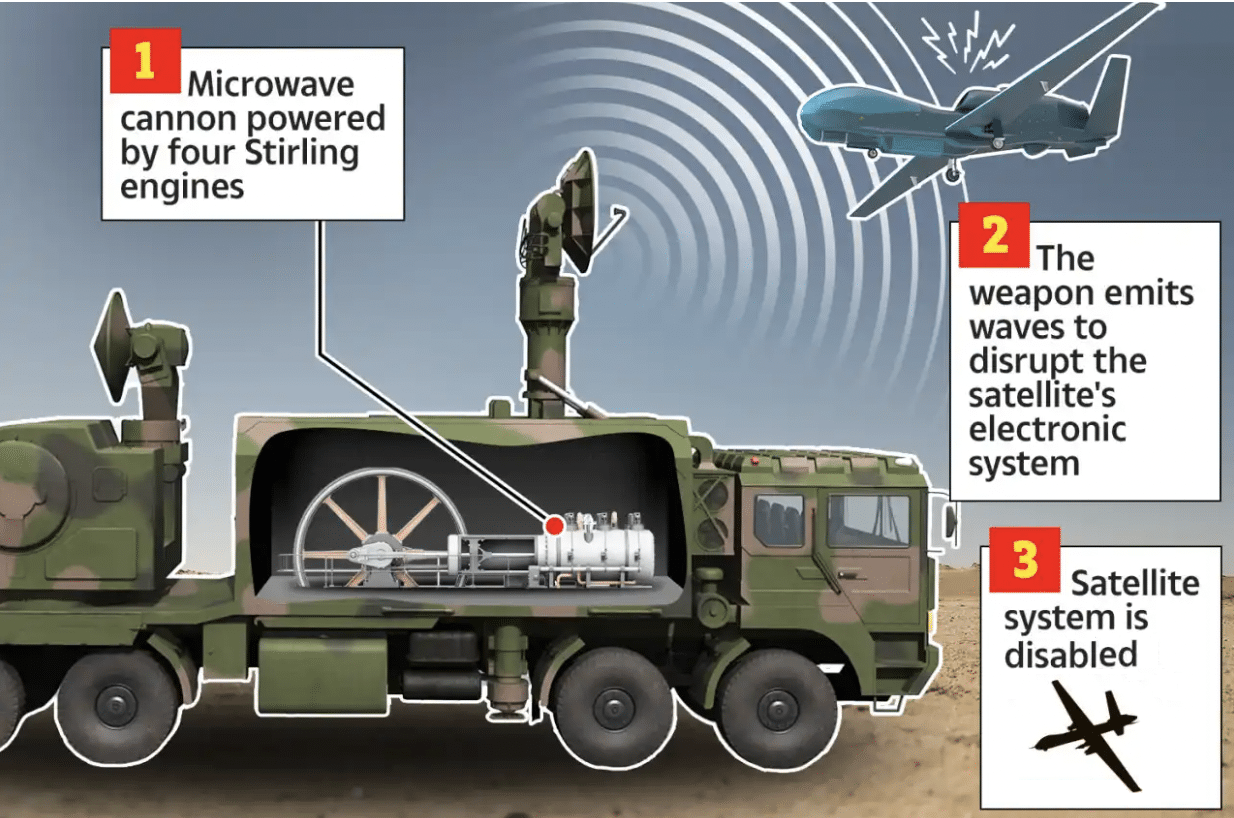
China is working on a new satellite-wrecking Death Star-like microwave weapon. Chinese scientists have reportedly developed a multi-beam converging microwave weapon. The new weapon is designed to combine several beams in one location with ultra-precise timing. This weapon could be used to target a single object with its multiple beams.
Similar in concept to the super laser from the Death Star battle station of Star Wars fame, the new Chinese weapon has completed experimental military trials. In the Star Wars universe, the Death Star’s main weapon uses “kyber” crystals to generate power.
This energy is then directed through several laser cannons, that merge at a single point to generate a beam so powerful it can blow apart entire planets. While impressive cinematically, this type of weapon has long been considered a complete fantasy.
According to reports, the new Chinese weapon employs multiple independent microwave-transmitting vehicles that can be deployed in different locations.
These individual vehicles are able to coordinate the focus of their beams into one location, merging and amplifying the power of an attack. This process is difficult, because each beam transmitter needs ultra-precise location and timing controls.
According to the research team’s calculations, each microwave vehicle must be deployed with a positional error of just a few millimeters. The time synchronization error between the vehicles must not exceed one hundred and seventy picoseconds.
This timing is more precise than the atomic clocks used in GPS satellites. However, such timing precision is not beyond the capabilities of Chinese scientists. Chinese scientists set a world record last year by using optical fiber to achieve a time synchronization accuracy of ten picoseconds over a distance of one thousand one hundred miles.
According to reports, the new Chinese weapon system requires seven transmitting vehicles. Chinese experiments have demonstrated that this device can disrupt signals from American GPS and other satellites.
Chinese scientists have also equipped each transmitting vehicle with laser-ranging auxiliary positioning devices to obtain the necessary millimeter-level coordinates.
A mobile command center controls the beams. This command center analyzes data from the various sensors and issues attack commands to the vehicles. According to an unnamed scientist involved in the project, the microwave beams can achieve a power-combining effect of “one and one equals more than two.”
Such a weapon could serve multiple purposes. These include education and training, verification of new technology, and military exercises. To maximize precision and accuracy, Chinese engineers connected the timing devices on the transmitting platforms using optical fibers to achieve ultra-high-time precision synchronization. This indicates that the trucks must be very near each other which may be difficult to achieve on an active battlefield.
Due to the project’s military sensitivity, the weapon’s performance parameters are confidential. A distributed structure could theoretically allow the power of an attack beam to increase indefinitely as more units are added. Previous research indicates that when the output of a directed energy weapon reaches one gigawatt, it can inflict significant damage on satellites in near-Earth orbit.
Obviously, that is significantly less than the kind of energy needed to destroy a target such as a planet. However, it could provide useful capabilities for the Chinese military.
China’s anti-satellite program -
Spacecraft – U.S. Space Force X-37B Finishes Seventh Mission – Part 2 of 2 Parts
Part 2 of 2 Parts
NASA has used aerobraking at Mars to alter the orbits of its scientific probes surveying the red planet. In 2014, the European Space Agency carried out a series of aerobraking maneuvers at Venus with its Venus Express spacecraft. Precise navigation is crucial for aerobraking. Coming in too high won’t produce enough air resistance to reduce velocity, while dipping too low could cause the spacecraft to reenter the atmosphere. The Space Force said it is using experience from civilian science missions to carry out the X-37B’s aerobraking maneuvers.
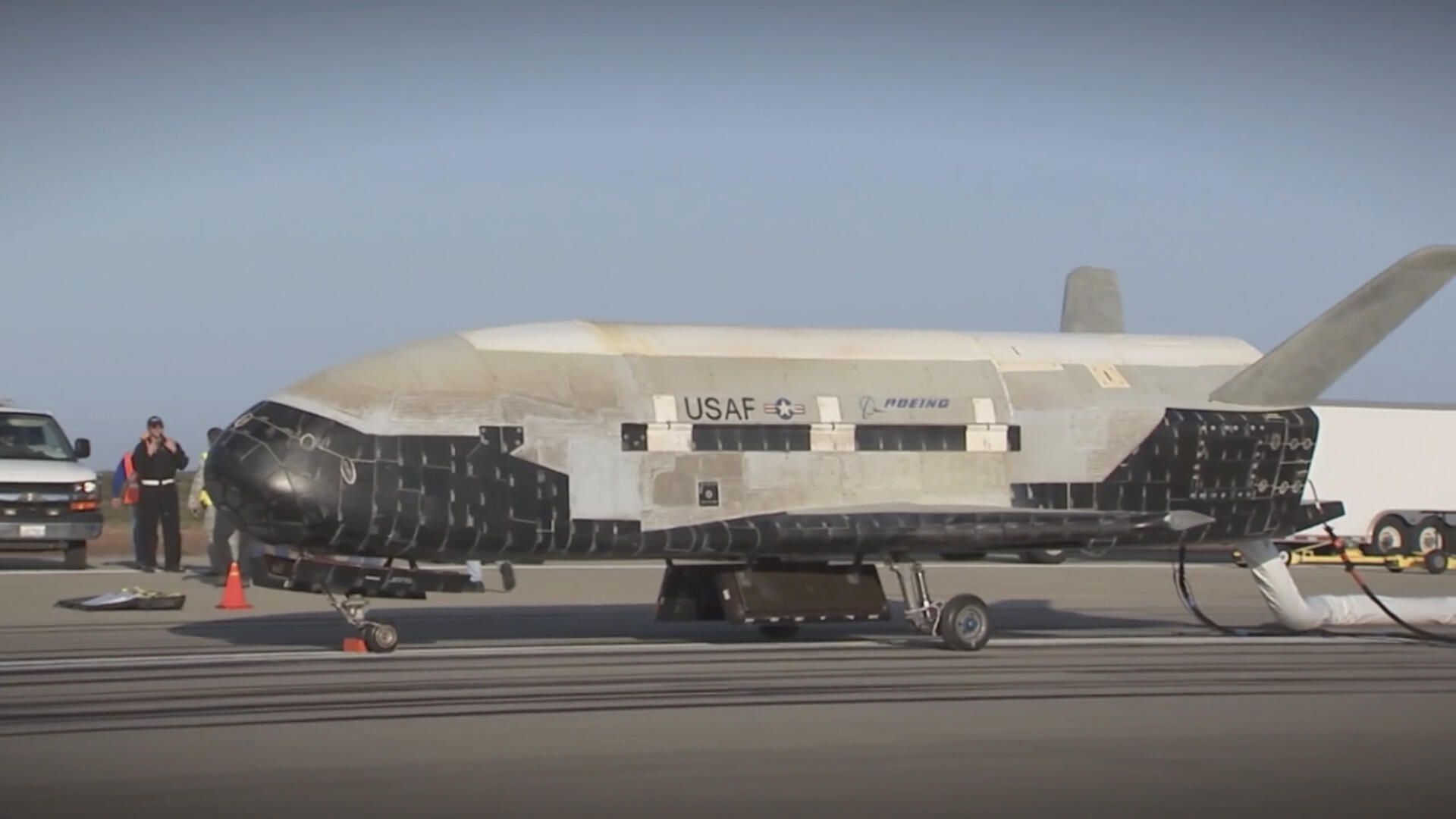
It appears that military officials have been planning this kind of maneuver with the X-37B for at least several years. In 2019, former Air Force Secretary Heather Wilson said that the spaceplane can fly in an orbit that “looks like an egg.” She was presumably referring to an elliptical orbit like the one the current mission is flying.
She added that “When it’s close to the Earth, it’s close enough to the atmosphere to turn where it is. Which means our adversaries don’t know—and that happens on the far side of the Earth from our adversaries—where it’s going to come up next. And we know that that drives them nuts. And I’m really glad about that.”
The Pentagon seldom releases an update on the X-37B spaceplane in the middle of a mission. During previous flights, military officials usually provided some basic information about the mission before its launch, then kept silent until the X-37B returned for landing. The military keeps specific details about the spaceplane’s activities in orbit a secret.
This made the Space Force’s announcement Thursday a surprise. When the seventh flight of the X-37B launched, there were indications that the spacecraft would reach a much higher orbit than it did on any of its prior six missions.
In February, a satellite tracking hobbyist spotted the X-37B in orbit by observing sunlight reflected off the spacecraft as it flew thousands of miles above the Earth. Additional detections confirmed the discovery, allowing amateur observers to estimate that the X-37B was flying in a highly elliptical orbit ranging between roughly three hundred miles and thirty-eight thousand and six hundred miles in altitude. The orbit was inclined fifty-nine degrees to the Earth’s equator.
On its previous missions, the X-37B stayed in low-Earth orbit a few hundred miles above the planet. When it became apparent that the latest mission was orbiting at a significantly higher altitude, analysts and space enthusiasts speculated on what the secret spaceplane was doing and how it would return to Earth. A direct reentry into the atmosphere from the spaceplane’s elliptical orbit would have exposed the craft’s heat shield to hotter temperatures than any of its previous landings.
With respect to what the X-37B is doing in orbit, the Space Force said the spaceplane on this mission has “conducted radiation effect experiments and has been testing space domain awareness technologies in a highly elliptical orbit.” The orbit brings the X-37B through the Van Allen radiation belts and crosses several orbits populated by U.S. and foreign communications, navigation, and surveillance satellites.
Military officials have said that previous X-37B flights have tested a Hall-effect ion thruster and other experimental space technologies without providing details. It has been reported that X-37Bs have also secretly deployed small military satellites in orbit.
Boeing X-37 -
Spacecraft – U.S. Space Force X-37B Finishes Seventh Mission – Part 1 of 2 Parts
Part 1 of 2 Parts
The U.S. Space Force said Thursday that after more than nine months in an unusual, highly elliptical orbit, the U.S. military’s X-37B spaceplane will soon begin dipping its wings into Earth’s atmosphere to lower its altitude before coming back to Earth for a runway landing. The X-37B is also called the Orbital Test Vehicle
The aerobraking maneuvers will utilize a series of passes through the upper fringes of the atmosphere to gradually reduce its speed with aerodynamic drag while expending minimal fuel. This reduction in velocity will bring the apogee, or high point, of the X-37B’s orbit closer to Earth.
The Space Force called the aerobraking a “novel space maneuver” and said it was intended to allow the X-37B to “safely dispose of its service module components in accordance with recognized standards for space debris mitigation.”
The reusable Boeing-built X-37B spaceplane is designed to land like an aircraft on a runway. The spaceplane service module, mounted to the rear of the vehicle, carries additional payloads. At the end of the mission, the X-37B will jettison the disposable service module before reentry. The Space Force doesn’t want this section of the spacecraft to maintain in its current high-altitude orbit and become a piece of space junk.
The Space Force said, “Once the aerobrake maneuver is complete, the X-37B will resume its test and experimentation objectives until they are accomplished, at which time the vehicle will deorbit and execute a safe return as it has during its six previous missions”.
The Space Force has identified mobility in orbit as a critical focus for its next-generation space missions. This mobility would allow satellites to more freely move between altitudes and orbital inclinations than they can today. Commanders don’t want a spacecraft’s movements to be constrained by the amount of fuel it carries. They want satellites to “maneuver without regret.”
Space Force leaders have been discussing in-orbit refueling, more efficient propulsion technologies, and other ways to achieve this end. Aerobraking is another way to reduce the altitude of a spacecraft’s orbit without using precious propellant.
General Chance Saltzman, the Space Force’s Chief of Space Operations said, “This first-of-a-kind maneuver from the X-37B is an incredibly important milestone for the United States Space Force as we seek to expand our aptitude and ability to perform in this challenging domain.”
Space Force officials did not say when the X-37B spaceplane will end its mission, which began on December 28th with a launch on a SpaceX Falcon Heavy rocket. The Space Force also did not say what orbit the X-37B will end up in after the aerobraking maneuvers. The spaceplane will presumably settle into a low-Earth orbit, where all of its previous missions were flown.
There are currently two X-37Bs in the Pentagon’s inventory. The spaceplanes have solar arrays to generate electricity and carry enough fuel to remain in orbit for years. The longest X-37B flight to date lasted more than nine hundred and eight days. The vehicles have cargo bay doors that open in space. The X-37B’s cargo bay is about the size of a pickup truck bed. The spacecraft measures twenty-nine feet long, which is about a quarter the length of a NASA space shuttle orbiter. It is not designed to carry passengers.
Please read Part 2 next
United States Space Force